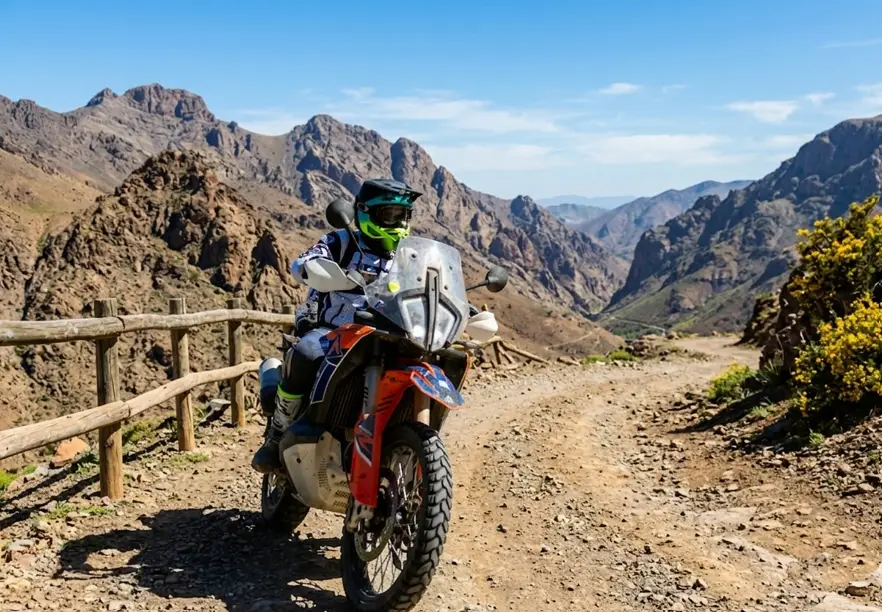
There is no riding quite like it. Switchback after switchback, the air growing cooler with every metre of altitude, a horizon of peaks opening up beyond the next bend — motorcycle riding in the mountains is the experience that draws most adventure riders to two wheels in the first place. But mountains reward preparation and punish complacency. Gradients are steeper, the weather turns faster, and the margin for error narrows the higher you climb.
This guide brings together the practical techniques, preparation and mindset that make mountain riding safe, smooth and genuinely unforgettable. Whether you are planning your first alpine pass or you already chase elevation every weekend, these tips will help you ride better — and enjoy every kilometre more. They are the same principles our guides apply on every route we lead at Adventure Motorcycle Tours, where the mountains are very much our natural habitat.
What makes motorcycle riding in the mountains different
Mountain riding combines three challenges that rarely appear together at lower elevations: constantly changing gradients, rapidly shifting weather, and roads that demand precise, repeated cornering. Add thinner air at altitude and an unforgiving environment if something goes wrong, and it becomes clear why the mountains test riders in a way that motorways and rolling country roads never will.
In short, the mountains ask more of both you and your motorcycle. The good news is that every one of those challenges can be managed with the right technique and preparation.
Before you ride: preparing for the mountains
Great mountain rides are won before the engine even starts. A little preparation removes most of the risk and lets you focus on the riding itself.
Check your motorcycle thoroughly
Mountains place sustained loads on your bike — long climbs, heavy engine braking on descents and repeated hard cornering. Before you set off, check your tyre pressures and tread, brake pads and brake fluid, chain tension and lubrication, and coolant level. Brakes in particular work much harder in the mountains, so worn pads that feel fine in town can become a real problem on a long descent.
Pack for weather that changes by the hour
Mountain weather is famously unpredictable. A sunny valley start can become a cold, wet pass within an hour, and temperatures drop roughly 6 °C for every 1,000 metres you climb. Layered clothing is the answer: a moisture-wicking base layer, an insulating mid-layer and a compact, fully waterproof outer shell you can pull on at a roadside stop. Always carry water and stay hydrated — altitude and concentration dehydrate you faster than you expect.
Plan your route, your fuel and your stops
Fuel stations are scarce in remote mountain areas, so plan your range conservatively and fill up whenever you can rather than gambling on the next village having a pump. Note your daily distance, the high passes you will cross and sensible stopping points. Riding the mountains is mentally demanding, and regular breaks keep your concentration sharp.
Essential techniques for motorcycle riding in the mountains
This is the heart of the matter. Master these techniques and mountain roads transform from intimidating to exhilarating.
1. Look through the corner, not at it. Your motorcycle follows your eyes. On tight mountain hairpins, turn your head and fix your gaze on the exit of the bend — where you want to go — rather than the apex or the edge of the road. This single habit smooths out your line and builds enormous confidence.
2. Set your speed before the bend, not in it. Brake on the straight as you approach a corner, then carry a steady or gently increasing throttle through it. Braking mid-corner unsettles the bike and reduces grip exactly when you need it most. The old advice holds: slow in, fast out.
3. Use engine braking on long descents. Downhill is where many riders get into trouble. Select a lower gear and let the engine help control your speed, rather than dragging the brakes continuously. Constant braking overheats discs and pads and leads to brake fade — a frightening loss of stopping power right when the next hairpin arrives. Engine braking keeps your brakes cool and ready.
4. Be smooth with the throttle. Mountain roads punish abrupt inputs. Roll the throttle on and off progressively, especially when surfaces may be loose or damp. Smoothness is not just elegant; it is the safest, fastest way through a sequence of bends.
5. Read the road surface constantly. Mountain tarmac hides gravel washed across the road, damp patches in shaded sections, fallen rocks, melting tar in the heat and the occasional patch of livestock. Cool, shaded corners stay slippery long after the sun has dried the rest of the road. Keep scanning ahead and adjust early.
6. Respect altitude. Above roughly 2,000 metres, even modern fuel-injected engines lose a little power as the air thins, and some riders feel mild fatigue or a slight headache. Keep a moderate pace on the highest passes, drink plenty of water, and simply open the throttle a touch more to compensate — nothing serious, just something to expect.
7. Ride your own ride. Never let a faster group, a tailgating car or your own ego push you beyond your comfort zone. The mountains will still be there next season. Riding within your limits is the difference between a story you tell with a smile and one you would rather forget.
The right gear for mountain riding
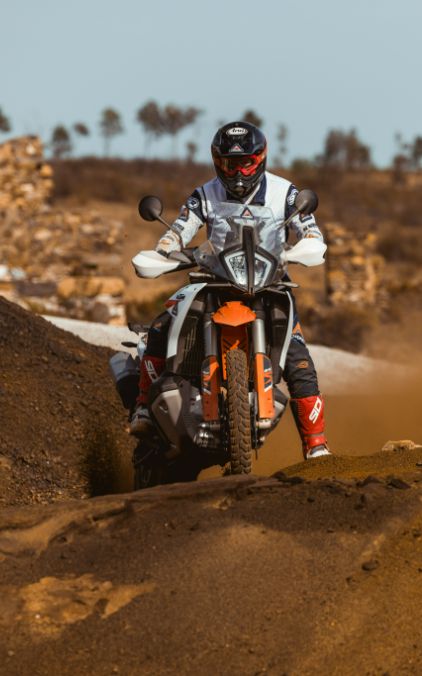
Mountain conditions make protective, adaptable gear non-negotiable. A quality helmet, armoured jacket and trousers, gloves and proper boots are the baseline. Beyond protection, prioritise gear that handles temperature swings: a jacket with a removable thermal liner and good ventilation earns its keep when you start in a warm valley and finish on a cold summit. A lightweight waterproof you can carry and deploy quickly is worth its weight in gold, and clear-and-tinted visor options help with the sharp light changes between bright peaks and dark, forested descents.
Where to ride: the best mountains for two wheels
Half the joy of mountain riding is choosing the destination. A few of the finest in Southern Europe and beyond:
- The Pyrenees. A coast-to-coast crossing of the Pyrenees is a bucket-list ride, with passes climbing well above 2,000 metres, technical mountain sections and a landscape that shifts from Mediterranean cliffs to alpine valleys. Our Pyrenees Motorcycle Tour runs from the Costa Brava to the Cantabrian Sea and captures all of it.
- Spain. From the Sierra Nevada to the rugged sierras of Andalusia, Spain offers some of the most varied mountain riding in Europe. Explore our Guided Motorcycle tours in Spain to ride them with local expertise.
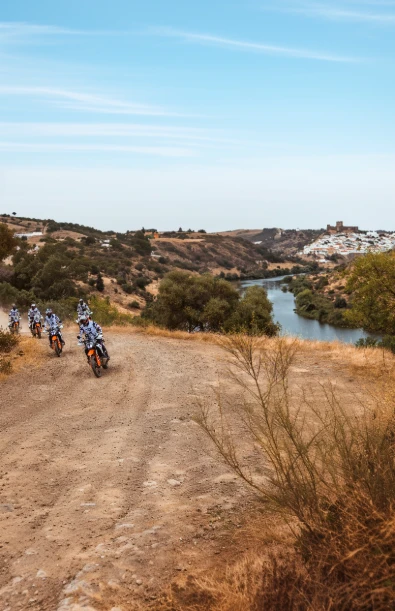
- Portugal. Quiet, sweeping mountain roads through the Serra and beyond make Portugal an underrated gem. See our Guided Motorcycle tours in Portugal.
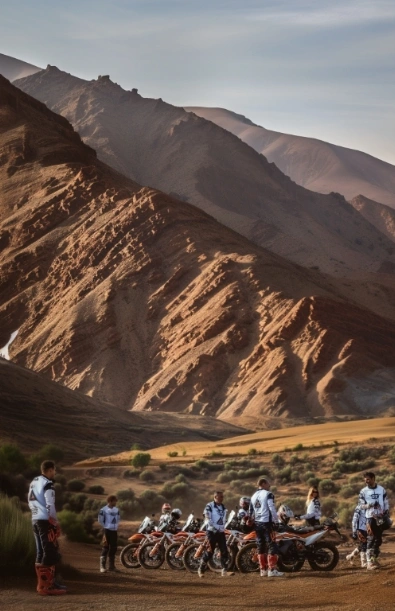
- Morocco. For mountains on an epic scale, the Atlas ranges are unmatched — high passes, remote valleys and unforgettable scenery. Discover our Guided Motorcycle tours in Morocco.
Why ride the mountains with Andries Adventures
Mountains are best enjoyed when the logistics, the route-finding and the risk management are handled for you — so all you have to do is ride. That is exactly what we do at Andries Adventures.
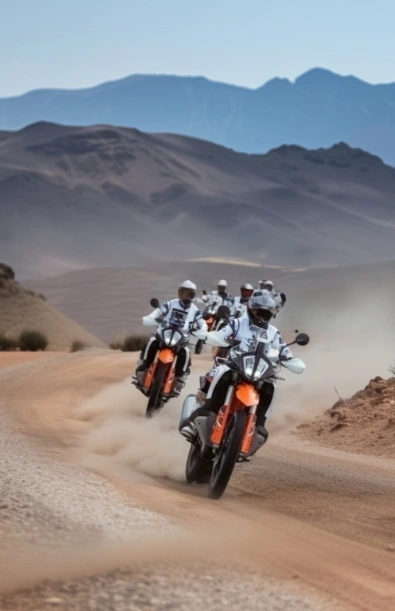
We design high-end, fully organised mountain adventures across Spain, Portugal, Morocco, the Pyrenees and beyond. Every one of our guided motorcycle tours is led by professional English- and Spanish-speaking guides who know each pass, each viewpoint and each technical section intimately — and who adapt the pace and route to your level, from confident beginner to seasoned rider. You ride a meticulously maintained KTM adventure machine, a support van carries your luggage and a mechanic is on hand, while charming hotels and local gastronomy round off each day. GPS tracks, accommodation and the welcome and farewell dinners are all taken care of.
The result is the mountain riding you came for, without the planning headaches — unfamiliar roads and genuinely unforgettable rides.
Frequently asked questions about motorcycle riding in the mountains
What is the most important skill for mountain riding?
Cornering control. Looking through the bend, setting your speed before you enter it and being smooth with the throttle will keep you safe and in control through almost any sequence of mountain curves.
How do I stop my brakes overheating on long descents?
Use engine braking. Drop into a lower gear and let the engine slow the bike, applying the brakes in firm, intermittent bursts rather than dragging them continuously. This prevents brake fade and keeps full stopping power available.
Do I need an adventure or trail motorcycle for the mountains?
Not necessarily for sealed mountain roads — many riders enjoy them on sports tourers and roadsters. But for routes that mix tarmac with gravel, forest tracks and technical sections, an adventure or trail bike such as a KTM 890 or 390 Adventure offers a clear advantage in comfort and capability.
What should I wear for riding in the mountains?
Full protective gear plus layered clothing for changing temperatures, and always a compact waterproof. Expect the temperature to fall noticeably as you climb, and pack so you can add or remove layers quickly at a roadside stop.
Is mountain riding suitable for beginners?
Yes — with the right preparation and pace. Choosing well-surfaced roads, riding within your limits and, ideally, joining a guided group lets newer riders build skills safely while still enjoying spectacular scenery.
Ready to ride?
Motorcycle riding in the mountains rewards riders who prepare well, ride smoothly and respect the terrain. Get those fundamentals right and the mountains become the most rewarding roads you will ever travel.
When you are ready to turn the theory into a real adventure, we would love to show you our favourite passes. Explore our full range of tours, pick your terrain, and let us handle the rest — see you on the mountain.